Cervical Lordosis Improvement and Patient-Reported Headache Resolution
A 12-year-old patient reported complete resolution of headaches after 24 individualized Chiropractic BioPhysics treatments. Cervical lordosis moved closer to the analysis reference value, while C2–C7 translation increased. These findings do not demonstrate improvement in every alignment measurement or establish that alignment changes caused symptom resolution.
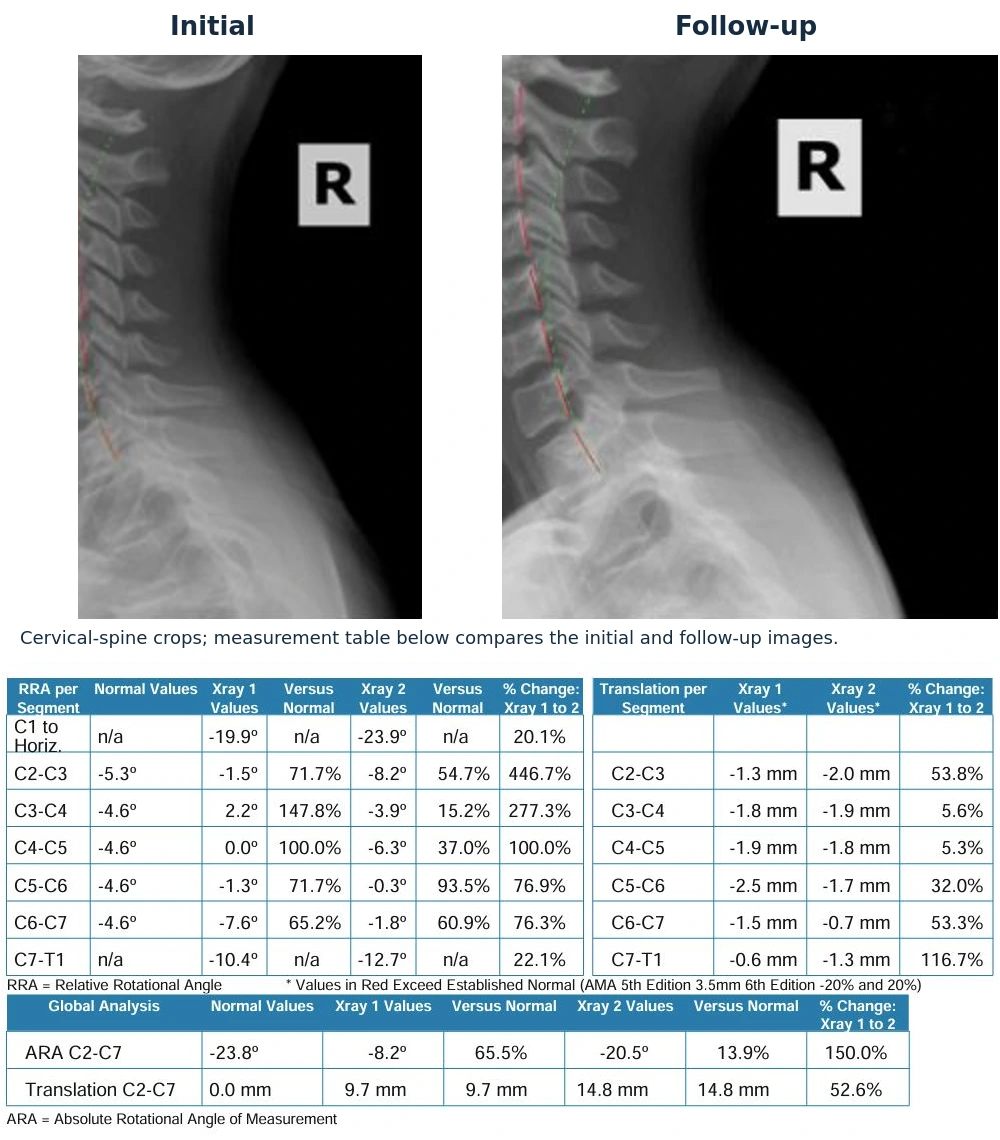
De-identified cervical-spine crops and the original measurement table. Xray 1 is the initial examination; Xray 2 is the follow-up. Exact examination dates and facial profiles are omitted. The table's reference values are analysis benchmarks, not proof of an ideal target for every child; percentage changes do not all indicate improvement.
Initial Presentation
A 12-year-old patient presented to Comprehensive Chiropractic Clinic in Murray, Utah, with recurring headaches that had persisted for several months. Clinical evaluation included radiographic assessment of cervical alignment. The measurements were considered alongside the clinical findings when developing an individualized care plan; the radiographs alone do not establish the cause of the headaches.
Clinical Findings
- Initial cervical lordosis (ARA C2–C7) measured −8.2°, compared with the −23.8° reference value used in the clinic's analysis. This reference is not presented as a universal pediatric normal or a required treatment target for every child.
- Initial C2–C7 translation measured 9.7 mm; the analysis table lists a 0.0 mm reference.
- The initial C3–C4 segmental angle was +2.2°, with C4–C5 measuring 0.0°. These measurements document local alignment rather than establishing a headache diagnosis.
The Corrective Strategy
The patient completed 24 individualized Chiropractic BioPhysics (CBP) treatments consisting of spinal traction, corrective exercises, and chiropractic adjustments. Care focused on the cervical alignment findings and the patient's clinical presentation. This describes the treatment provided in this individual case, not a recommendation that all children with headaches receive imaging, traction, or chiropractic treatment.
Objective Outcomes
- Cervical lordosis (ARA C2–C7) changed from −8.2° to −20.5°, a 12.3° increase in lordotic curvature toward the −23.8° reference used in the analysis.
- C2–C7 translation increased from 9.7 mm to 14.8 mm, a 5.1 mm increase. This moved farther from the table's 0.0 mm reference and is not described as an improvement.
- The C3–C4 segmental angle changed from +2.2° to −3.9°; C4–C5 changed from 0.0° to −6.3°. Segmental changes should be interpreted individually, not as uniform normalization.
- Following the 24-treatment program, the patient reported complete resolution of headaches. This is a patient-reported outcome, separate from the radiographic measurements.
- The case documents improvement in lordosis alongside increased translation. It does not show that every radiographic measurement improved, and it cannot establish that treatment or alignment changes caused the reported headache resolution.
Key Takeaway
Structural measurements and patient-reported symptoms describe different aspects of an outcome. In this case, lordosis improved toward the analysis reference and headaches reportedly resolved, but translation increased. An individual case without a control group cannot establish causation, predict another patient's outcome, or determine the long-term durability of symptom resolution.
This case is presented for educational purposes with publication authorization. Results vary and are not guaranteed. Radiographs must be interpreted in the context of a complete clinical examination. Imaging is not routinely indicated for uncomplicated pediatric headaches and should be performed only when clinically justified. Persistent or concerning headaches in a child warrant appropriate medical evaluation. This case does not replace individualized medical care.