15+ Years of Chronic Headaches and Migraines: A Cervical Structural Correction Case Study
An adult female patient with more than 15 years of chronic headaches and migraines reports no current headaches or migraines. During 12 visits at CCC, cervical lordosis increased in magnitude while C2–C7 translation also increased. Earlier care elsewhere and unconfirmed symptom timing limit interpretation of this individual outcome.
Patient Profile
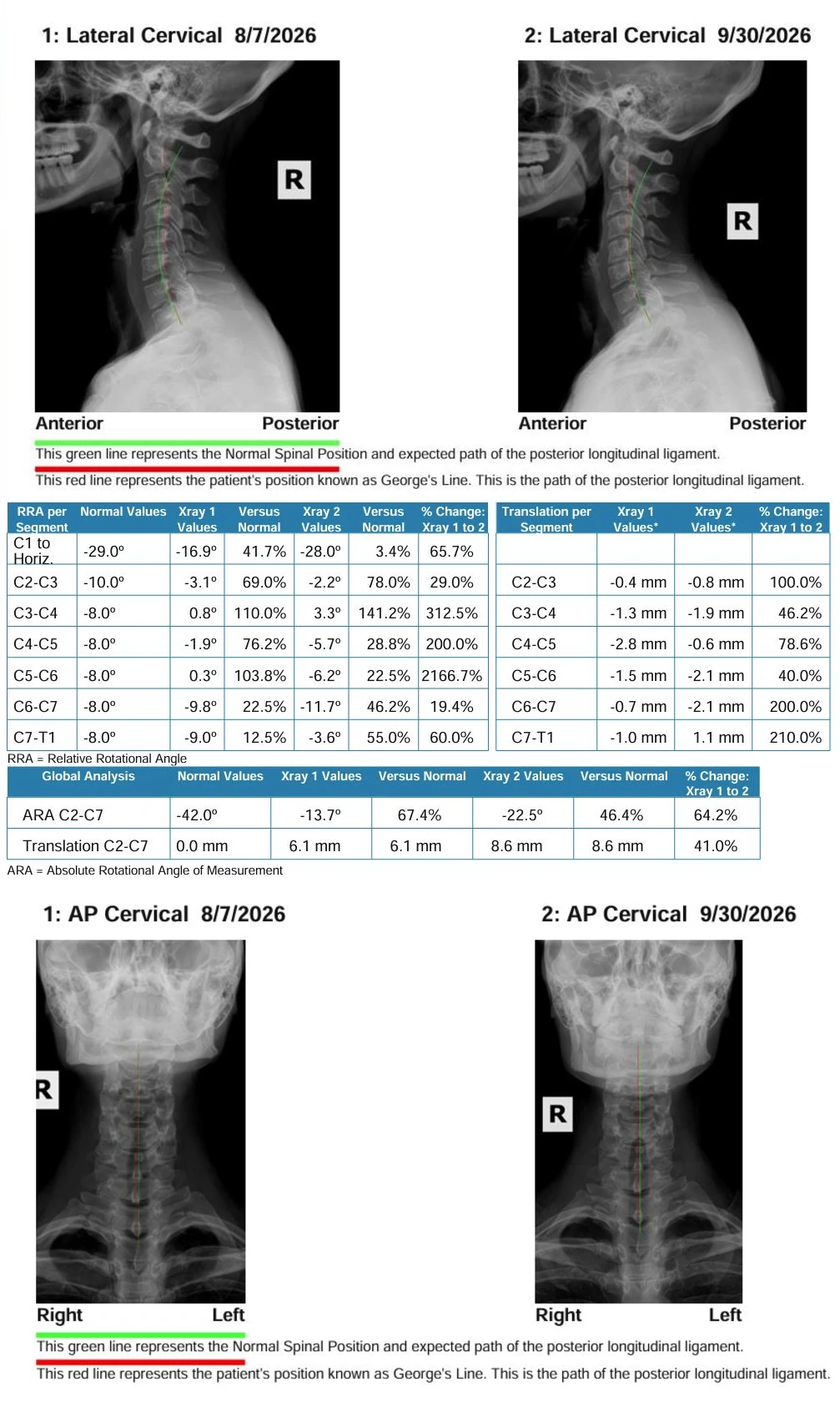
Top: lateral cervical comparison. Middle: original measurement table. Bottom: AP cervical comparison. Examination dates document the clinical timeline. The images' reference curves and table values are analysis benchmarks, not universal treatment targets. Percentage changes do not all indicate improvement; C2–C7 translation increased.
Initial Presentation
An adult female patient reported chronic headaches for more than 15 years, including debilitating migraines approximately two to three times per week. Episodes frequently required her to lie down in a dark room. Before relocating to Utah, she had begun corrective chiropractic care with another provider; her earlier cervical C2–C7 absolute rotational angle (ARA) was reportedly +7.2°. She subsequently continued structural corrective care at Comprehensive Chiropractic Clinic in Murray, Utah. The earlier measurement is reported history, separate from the two CCC examinations shown here.
Clinical Findings
- On August 7, 2026, cervical lordosis (C2–C7 ARA) measured −13.7°. Its magnitude was reduced relative to the −42° reference used in the clinic's CBP analysis; this benchmark is not a universal required treatment target.
- Initial C2–C7 translation measured 6.1 mm.
- The initial C1-to-horizontal angle measured −16.9°. Radiographic measurements document alignment but do not independently establish the cause of headaches or migraines.
The Corrective Strategy
The patient completed 12 visits from August 7 to September 30, 2026, in an individualized Chiropractic BioPhysics (CBP) rehabilitation program. In-office exercises included whole-body vibration plate exercises with head and body weighting, mirror-image corrective exercises, and prolordotic exercises. Home rehabilitation included mirror-image translation exercises, FLIP exercises, and lumbar stabilization exercises. Care also included mirror-image adjustments, instrument-assisted chiropractic adjustments, and CBP-specific corrective spinal traction using the UTS traction system. Traction positioning was selected according to the patient's structural findings and corrective care objectives.
Objective Outcomes
- Cervical lordosis (C2–C7 ARA) changed from −13.7° on August 7, 2026, to −22.5° on September 30, 2026: an 8.8° increase in lordosis magnitude over 12 visits.
- C2–C7 translation increased from 6.1 mm to 8.6 mm, a 2.5 mm increase. This is not characterized as an improvement.
- The C1-to-horizontal angle changed from −16.9° to −28.0°, a signed change of −11.1°. Individual measurements should be interpreted separately, not as uniform improvement.
- Separately from these radiographic findings, the patient reports no current headaches or migraines and describes their absence since beginning treatment. The precise timing of symptom resolution remains unconfirmed.
- Because treatment began before she arrived at CCC, the reported symptom resolution cannot be attributed specifically to the 12 CCC visits.
Key Takeaway
This case documents measurable cervical alignment changes during multimodal structural rehabilitation alongside a favorable patient-reported headache history. Lordosis increased in magnitude, but translation also increased. A single case cannot establish that cervical alignment correction caused migraine resolution. Multiple interventions, earlier treatment elsewhere, and uncertain symptom timing limit causal interpretation; these observations do not predict outcomes for other patients.
Individual results vary. This case is educational and does not establish that chiropractic treatment or cervical alignment correction is effective for migraine disorders generally.