Cervical & Thoracic Structural Correction
A patient presenting with neck pain, midback pain, GERD, dyspnea, and headaches achieved measurable structural improvements across both the cervical and thoracic spine — including a 60.4% reduction in forward head translation — within 7 weeks of CBP care.
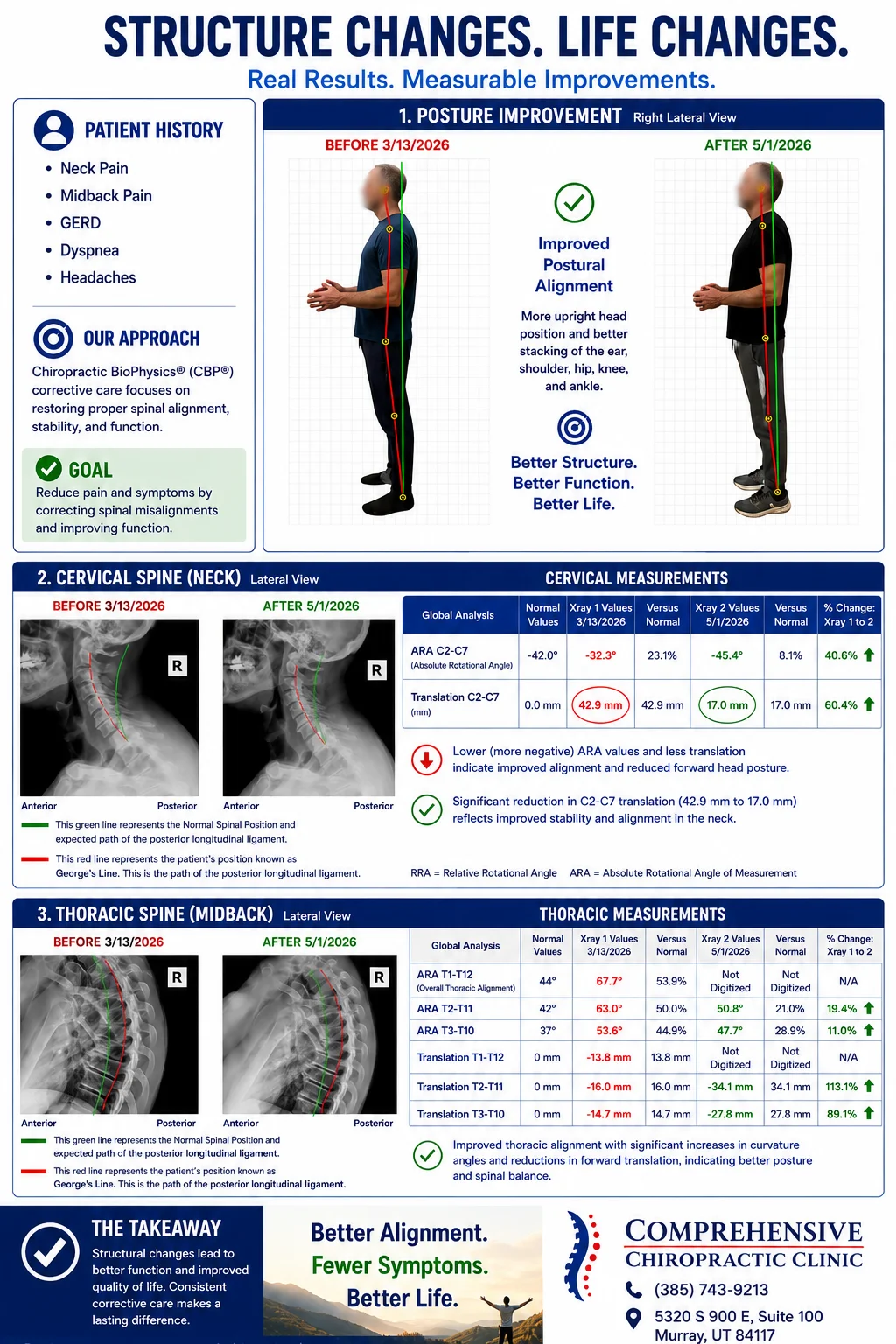
Actual patient x-rays. Individual results may vary based on age, severity, and compliance.
Initial Presentation
The patient presented with a complex symptom picture including neck pain, midback pain, GERD, dyspnea, and headaches. X-ray analysis (3/13/2026) revealed significant structural deviations in both the cervical and thoracic spine — including dangerous forward head translation and hyperkyphotic thoracic angles well outside normal ranges. The goal of care was to correct these underlying structural misalignments to reduce symptoms and improve function.
Clinical Findings
- Cervical ARA C2-C7 of -32.3° versus a normal of -42.0° — 23.1% deviation indicating a loss of the natural neck curve
- Cervical translation C2-C7 of 42.9mm versus a normal of 0.0mm — severe forward head posture placing excessive load on the cervical spine
- Thoracic ARA T2-T11 of 63.0° versus a normal of 42° — 50.0% deviation indicating hyperkyphosis (excessive rounding)
- Thoracic ARA T3-T10 of 53.6° versus a normal of 37° — 44.9% deviation
- Thoracic translation T2-T11 of -16.0mm and T3-T10 of -14.7mm — indicating abnormal thoracic spinal alignment
The Corrective Strategy
A comprehensive Chiropractic BioPhysics (CBP) corrective protocol was designed targeting both the cervical and thoracic spine simultaneously. Care included mirror-image postural adjustments, cervical and thoracic extension traction, and specific postural rehabilitation exercises performed both in-clinic and at home. The program ran from 3/13/2026 to 5/1/2026.
Objective Outcomes
- Cervical ARA C2-C7 improved from -32.3° to -45.4° — a 40.6% correction toward the normal -42.0°
- Cervical translation C2-C7 reduced dramatically from 42.9mm to 17.0mm — a 60.4% reduction in forward head posture
- Thoracic ARA T2-T11 improved from 63.0° to 50.8° — a 19.4% correction toward normal
- Thoracic ARA T3-T10 improved from 53.6° to 47.7° — an 11.0% correction
- Thoracic translation T2-T11 improved 113.1% and T3-T10 improved 89.1%, reflecting restored thoracic spinal balance
- Visible improvement in full-body postural alignment confirmed by standing lateral photographs