Forward Head Posture Treatment in Murray, Utah
Understanding—and Measuring—Forward Head Posture
Forward head posture describes a position in which the head is carried forward relative to the trunk. You may also hear terms such as anterior head translation or “tech neck.”
But seeing someone's head forward does not automatically tell us why it is there, whether it is structurally significant, or whether it is causing their symptoms.
At Comprehensive Chiropractic Clinic, Dr. Dirk Woodmansee evaluates posture as part of a broader clinical picture—including symptoms, spinal structure, neurological findings, movement and, when appropriate, objective postural or radiographic measurements.
The goal isn't simply to tell you to “stand up straighter.”
It is to determine what is measurable, what is clinically meaningful, and whether structural rehabilitation is appropriate for you.
What Is Forward Head Posture?
The head normally sits in a relationship with the shoulders, thoracic spine and cervical spine below it.
With forward head posture, the head is translated farther forward relative to the trunk.
That translation is important to distinguish from another measurement: cervical lordosis, or the curvature of the cervical spine.
A person can have:
- increased anterior head translation;
- an altered cervical curve;
- both findings together;
- or a temporary forward position related to a particular activity.
These are related concepts, but they are not the same measurement.
That's one reason Dr. Woodmansee doesn't evaluate forward head posture from appearance alone.
How Is Forward Head Posture Measured?
Forward head posture can be evaluated in different ways depending upon the clinical question.
A postural examination may assess the position of the head relative to the trunk and shoulders. Research studies frequently use photographic measurements such as the craniovertebral angle to quantify forward head posture.
When cervical radiographs are clinically appropriate, additional measurements can evaluate spinal alignment, including anterior head translation and cervical lordosis.
At Comprehensive Chiropractic Clinic, objective measurements allow us to ask better questions:
How far is the head translated?
What does the cervical curve look like?
Are those findings changing over time?
And just as importantly:
Do those measurements matter in the context of this patient's symptoms and examination?
Does Forward Head Posture Cause Neck Pain or Headaches?
This deserves a more careful answer than simply saying yes.
Forward head posture has been associated with neck pain in some populations, and altered cervical posture may coexist with neck pain, muscle fatigue, headaches and other complaints.
But an association does not mean that forward head posture is the cause of every patient's symptoms.
Neck pain and headaches can have many potential contributors. Numbness, tingling, weakness, severe headaches and other neurological symptoms can also require evaluation for conditions that have little or nothing to do with posture.
That is why we don't diagnose the source of someone's symptoms simply by looking at their posture.
Instead, we ask whether a measured structural finding is clinically relevant to that individual patient.
What About “Tech Neck”?
Phones, computers and other activities can put us in prolonged flexed or forward-head positions.
That doesn't mean everyone who looks down at a phone has developed a structural spinal disorder.
The distinction is between a temporary position and a persistent postural or structural finding that remains present when the person is assessed under standardized conditions.
If you're concerned that your posture has changed, the useful question isn't:
“How many pounds heavier has my head become?”
It's:
“Is there a measurable postural or structural change, and does it matter for me?”
That's something we can evaluate.
How Dr. Woodmansee Evaluates Forward Head Posture
A structural evaluation begins with the patient—not the X-ray.
1. History and Symptoms
Dr. Woodmansee considers when the problem began, activities or injuries that may be relevant, symptom patterns, previous treatment and how the problem affects daily function.
2. Clinical and Neurological Examination
Neck motion, orthopedic and neurological findings and other examination findings help determine whether a postural finding is likely to be clinically relevant—or whether another problem needs to be investigated.
3. Postural and Structural Assessment
The relationship of the head, cervical spine, thoracic spine and overall posture can be evaluated rather than treating the head position as an isolated finding.
4. Imaging When Clinically Appropriate
Not every patient with forward head posture needs an X-ray.
When radiographic evaluation is appropriate, cervical images can provide objective measurements of alignment that cannot be determined accurately from appearance alone.
5. Individual Care Selection
The purpose of the evaluation is not to put everyone into a posture-correction program.
Some patients may be appropriate candidates for structural rehabilitation. Others may need symptom-focused care, additional imaging, medical evaluation, specialist referral—or no corrective program at all.
Forward Head Posture and Cervical Lordosis Are Not the Same Thing
This distinction is central to how we evaluate cervical structure.
Anterior head translation describes how far forward the head is positioned.
Cervical lordosis describes the sagittal curvature of the cervical spine.
One can change without the other changing by the same amount.
That means simply “getting the head back” isn't necessarily the same thing as changing cervical curvature.
When radiographic measurements are clinically appropriate, Dr. Woodmansee can evaluate these structural variables separately and compare them over time.
What Is Chiropractic BioPhysics® Structural Rehabilitation?
Dr. Woodmansee holds Advanced Certification in Chiropractic BioPhysics® (CBP).
CBP is a structural rehabilitation approach that uses objective postural and spinal measurements to help determine individualized corrective strategies.
Depending upon the patient's findings and tolerance, a corrective program may include:
Mirror-Image® Exercises
Exercises may be prescribed in directions intended to address measured postural displacement and improve postural control.
Chiropractic Adjustments
Adjustments may be incorporated as one component of the patient's overall care plan when clinically appropriate.
Cervical Extension Traction
For selected patients with measured cervical alignment findings, specific traction methods may be used as part of a program intended to change cervical alignment over time.
The exact setup matters.
There is no single traction configuration that is appropriate for every cervical posture.
Postural Rehabilitation and Stabilization
Exercise and rehabilitation may be used to improve strength, control and the patient's ability to function with their changing posture.
Can Forward Head Posture Actually Change?
Yes—measured posture and cervical alignment can change in selected patients.
The more important question is how much change occurs, under what treatment protocol, in which patients, and whether the change is maintained.
A 2003 nonrandomized controlled clinical trial by Harrison and colleagues evaluated a CBP cervical extension-compression traction protocol combined with cervical manipulation. The treatment group demonstrated measurable radiographic changes, including a mean 11 mm reduction in anterior head weight-bearing and changes in cervical lordosis. Twenty-one treated participants underwent additional follow-up averaging 14 months, with the reported alignment improvements maintained in that subset.
A 2023 randomized controlled study examined 66 older adults with chronic nonspecific neck pain and forward head posture. Both groups received rehabilitation; the CBP group received mirror-image exercise and a Denneroll cervical traction orthotic, while the comparison group performed standardized stretching and strengthening. The CBP group demonstrated improvement in the study's forward-head-posture measurement, with differences between groups also present at three-month follow-up.
These studies don't mean every patient will achieve the same structural change.
They demonstrate something more useful: posture and cervical alignment are measurable outcomes that can change under specific rehabilitation protocols in selected study populations.
How Do We Know Whether Treatment Is Working?
Structural rehabilitation should give us something more objective than:
“It looks better.”
When appropriate, Dr. Woodmansee compares the measurements used at the beginning of care with follow-up findings.
That may include changes in:
- anterior head translation;
- cervical lordosis;
- postural alignment;
- symptoms and functional limitations;
- movement or examination findings.
Structural improvement and symptom improvement are related questions, but they are not automatically the same outcome.
A patient may feel better without achieving a particular structural target. Conversely, a measurable structural change does not prove that every symptom was caused by the original alignment.
That distinction is important when evaluating results.
A Measured Example From Our Clinic
Cervical & Thoracic Structural Correction — Individual Case
In this individual case, cervical radiographic measurements were obtained before and after a seven-week rehabilitation period.
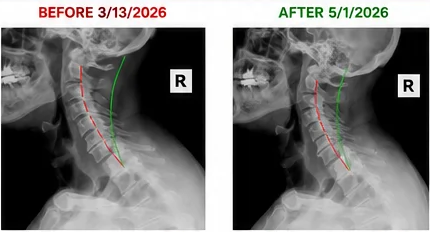
C2–C7 translation:
42.9 mm → 17.0 mm
Cervical ARA C2–C7:
−32.3° → −45.4°
The patient's program included mirror-image postural adjustments, cervical and thoracic extension traction, and in-clinic and home postural rehabilitation exercises.
These measurements show what changed in this individual patient. They do not predict how another patient will respond, and they do not by themselves establish that a particular symptom was caused—or resolved—by the measured alignment.
View the Individual CaseWhy Comprehensive Chiropractic Clinic?
Forward head posture is easy to see.
Understanding what it means is harder.
Dr. Dirk Woodmansee has been in clinical practice since 1997 and holds Advanced Certification in Chiropractic BioPhysics®.
At Comprehensive Chiropractic Clinic, structural findings aren't considered in isolation. Dr. Woodmansee looks at the patient's history, symptoms, neurological and clinical examination, posture, spinal alignment and imaging when appropriate.
When structural rehabilitation is indicated, we can establish measurable findings at the beginning of care and reassess them rather than relying only on appearance.
The goal isn't to promise a “perfect posture.”
It's to determine whether there is a meaningful structural problem, whether it is appropriate to address it, and whether the measurements actually change.
Research & Clinical Context
The trial reported measurable changes in cervical alignment and anterior head weight-bearing following the studied treatment protocol. Because the trial was nonrandomized and used a specific intervention and selected population, its findings should not be generalized to every patient.
This randomized trial involved 66 older adults with chronic nonspecific neck pain and forward head posture and compared two rehabilitation approaches over six weeks with three-month follow-up. The population and protocol matter when interpreting the results.
The review identified nine controlled trials meeting its criteria. Across those studies, cervical extension-traction protocols were associated with increases in radiographically measured cervical lordosis in selected populations. The included studies varied in protocol and population.
Some authors in the cited CBP literature report professional or commercial relationships with Chiropractic BioPhysics organizations or related rehabilitation methods. Study design, population and disclosed conflicts are important considerations when interpreting the evidence.
Related Conditions & Treatments
Medically Reviewed
The clinical information on this page has been reviewed and verified by Dr. Dirk Woodmansee, DC, an advanced certified Chiropractic BioPhysics (CBP) provider in clinical practice since 1997, with extensive experience in structural spinal rehabilitation.
Last Reviewed: September 2026 | Disclaimer
Schedule a Structural Evaluation in Murray
If you're concerned about forward head posture, changes in your cervical curve, persistent neck symptoms or a postural change that hasn't improved, the first step is determining what is actually present and whether it needs treatment.
At Comprehensive Chiropractic Clinic, Dr. Woodmansee can evaluate your posture, clinical findings and spinal structure and determine whether corrective CBP care—or another next step—is appropriate.
Comprehensive Chiropractic Clinic is located in Murray, Utah, serving patients throughout the Salt Lake Valley.