The Glue Holding Your Spine Together
Ligaments are the tough, fibrous bands of tissue that connect bone to bone. They are the "glue" that holds your spine together and prevents your vertebrae from sliding around when you bend, twist, or lift.
During a traumatic event like an auto accident or whiplash, these ligaments are stretched beyond their limits and tear. This is called ligament laxity, and it results in spinal instability—meaning your bones move too much, crushing the discs and nerves between them.
Understanding Ligament Injury & Biomechanics
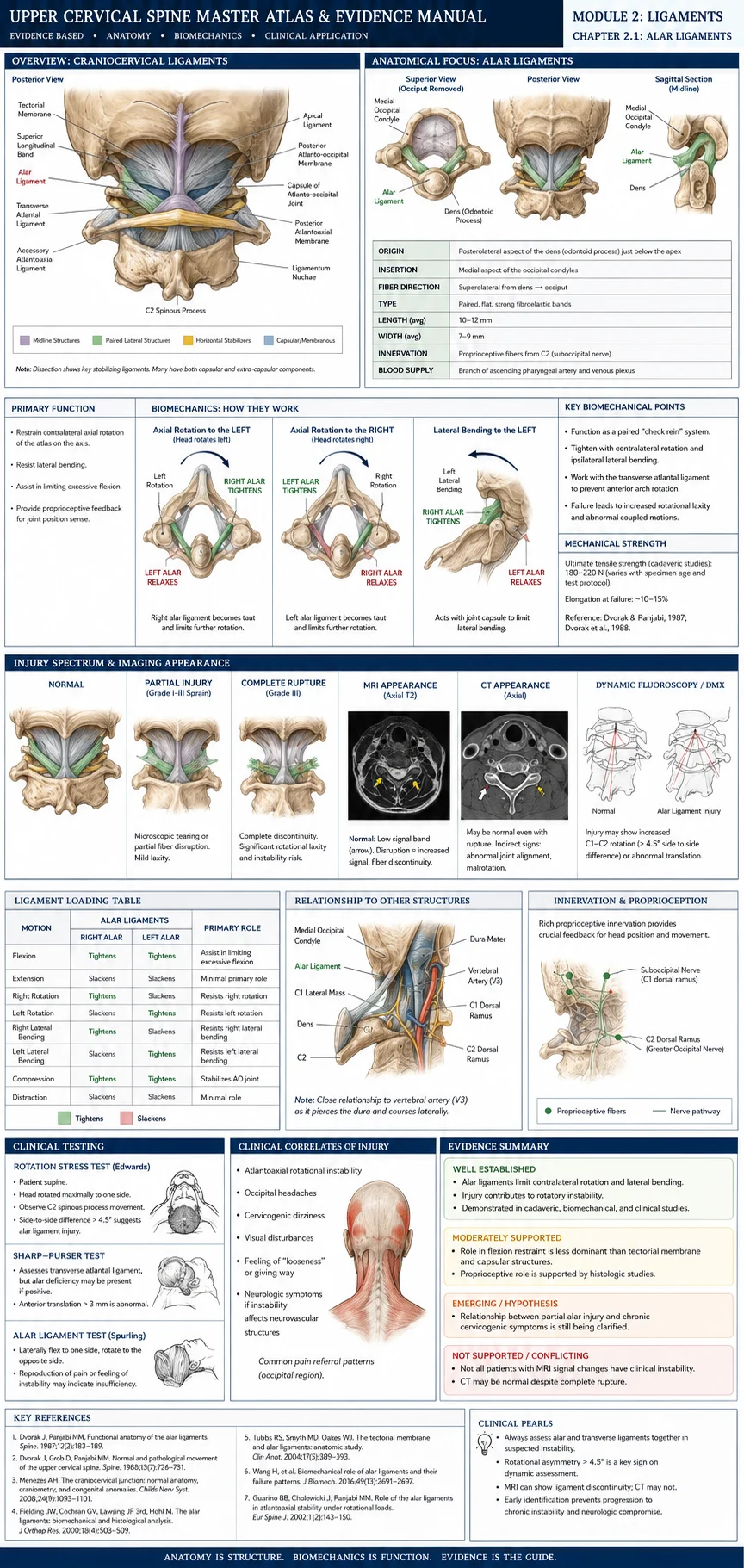
Spinal ligaments restrict abnormal translation and rotation of the spine. The graphic below illustrates the biomechanics of the delicate upper cervical ligaments and how tears (seen via MRI or DMX) compromise stability.
How We Find and Fix Ligament Damage
- Finding The Tear (DMX)Because you can't see ligaments on a normal X-ray, we utilize Digital Motion X-Ray (DMX) to watch your spine move under fluoroscopy. If a ligament is torn, we will see the bones slide abnormally.
- Restoring Proper MechanicsA spine with a torn ligament is unstable. We use Corrective Chiropractic Care to ensure the rest of the spine is perfectly aligned so the damaged joint isn't bearing excessive weight.
- Deep Tissue RehabThrough auto injury rehab and targeted therapies, we stimulate blood flow to the injured ligaments to promote dense, healthy scar tissue formation instead of weak, chaotic scar tissue.
Related Conditions & Treatments
Medically Reviewed
The clinical information on this page has been reviewed and verified by Dr. Dirk Woodmansee, DC, an advanced certified Chiropractic BioPhysics (CBP) provider in clinical practice since 1997, with extensive experience in structural spinal rehabilitation.
Last Reviewed: September 2026 | Disclaimer
Related Services
Schedule an Evaluation in Murray
If you live in the Salt Lake Valley and are struggling with a ligament injury, arm or leg numbness, or have been diagnosed with a spinal condition, contact Comprehensive Chiropractic Clinic to determine whether corrective CBP® care may be appropriate for your condition.
Conveniently Located in Murray, UT
Proudly serving patients from Salt Lake City, Holladay, Millcreek, Cottonwood Heights, Sandy, West Jordan, South Jordan, and surrounding Utah communities.