Is Your Head Really “Too Far Forward”? What Forward Head Posture Measurements Actually Mean
By Dr. Dirk Woodmansee
Published
If you've ever seen a side-view photo of yourself and thought, “My head looks like it's sitting too far forward,” you're not alone.
Phones, computers, driving, workstations and everyday habits have made terms like “forward head posture” and “tech neck” common. But there's an important distinction that often gets lost online:
Looking forward doesn't automatically tell us what is happening structurally in your cervical spine—and an abnormal posture measurement doesn't automatically explain why you hurt.
At Comprehensive Chiropractic Clinic, I prefer to measure what we can measure, examine the person attached to those measurements, and then decide whether the findings are clinically meaningful.
What is forward head posture?
Forward head posture describes a position in which the head is translated forward relative to the torso.
From the side, the ear and head may appear farther forward than expected in relation to the shoulders and trunk. Clinically, however, simply looking at someone's posture is only part of the picture.
There are different ways researchers and clinicians quantify head position. Some studies use photographic measurements such as the craniovertebral angle. In structural chiropractic assessment, lateral cervical radiographs can also be analyzed to quantify the position of the head relative to the lower cervical spine.
That gives us something more useful than saying, “Your posture looks bad.”
It gives us a measurement.
Forward head position and cervical lordosis are not the same measurement
This is one of the most important concepts I explain to patients.
Your cervical spine normally has a curve when viewed from the side. That curvature is called cervical lordosis.
Forward head translation describes where the head is positioned relative to the spine and torso.
Cervical lordosis describes the shape and alignment of the cervical curve.
They are related biomechanical characteristics, but they are not interchangeable.
Someone can have forward translation of the head with one cervical curve configuration, while another person with a similar-looking posture may have a very different cervical alignment.
That's one reason I don't believe a posture photograph by itself tells the entire story.
Does forward head posture mean something is wrong?
Not necessarily.
A measurement is a finding—not a diagnosis by itself.
Research has examined relationships between forward head posture, cervical alignment, neck pain and disability, but association should not automatically be interpreted as proof that a particular posture is causing an individual's symptoms.
For example, a 2023 randomized clinical study of 66 older adults specifically examined people with forward head posture and chronic nonspecific neck pain. The researchers measured posture as well as pain, balance, head-position accuracy and cervical range of motion.
That kind of research is useful, but it doesn't mean that every person with forward head posture has neck pain—or that correcting one measurement will necessarily eliminate someone's symptoms.
That's where an individualized examination matters.
What do I look at besides posture?
When I evaluate someone with suspected forward head posture or cervical structural changes, I don't make a treatment decision from one number.
I consider the measurement alongside things such as:
- the patient's history and symptoms;
- neurological, orthopedic and functional examination findings;
- overall posture and movement;
- cervical structural alignment;
- cervical lordosis;
- previous injuries or trauma; and
- imaging when it is clinically appropriate.
The question isn't simply:
“Is your head forward?”
The better question is:
“What does this finding mean in the context of you?”
That distinction is important.
Can forward head posture and cervical alignment change?
In appropriately selected patients, research indicates that measurable cervical posture and alignment can change.
A 2003 nonrandomized controlled clinical trial investigated a Chiropractic BioPhysics® cervical extension-traction protocol in patients selected for loss of cervical lordosis. The investigators reported measurable increases in cervical lordosis in the treatment group.
A 2021 systematic review examined controlled trials involving cervical extension traction for patients with cervical hypolordosis and spinal disorders. Nine trials met the review's inclusion criteria, with the included studies reporting measurable increases in cervical lordosis following extension-traction rehabilitation programs.
And in the 2023 randomized study mentioned earlier, researchers compared two approaches for older adults with forward head posture and chronic nonspecific neck pain. Both groups received exercise-based interventions, while one included a CBP® mirror-image exercise and cervical traction approach. The study reported differences between groups in several measured outcomes over treatment and follow-up.
These studies do not establish that every patient requires structural rehabilitation or that every patient's posture can or should be changed.
They do demonstrate something important:
Spinal alignment is measurable, and under certain clinical circumstances it can also be a measurable outcome of rehabilitation.
An example from our clinic
One reason I believe objective reassessment matters is that it allows us to compare where a patient started with what actually changed.
In one individual case from our clinic—Case 005—cervical measurements were taken before and after a course of structural rehabilitation.
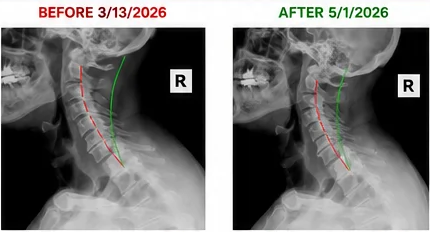
The patient's measured C2–C7 anterior head translation changed from:
42.9 mm → 17.0 mm
The measured cervical absolute rotation angle (ARA C2–C7) changed from:
−32.3° → −45.4°
Those are objective changes in that individual's measured cervical alignment.
They are not a promise of what will happen for another patient, and the measurements by themselves do not establish that a particular symptom was caused—or resolved—by the structural changes.
That's precisely why I prefer showing measured results rather than making broad promises.
Where does Chiropractic BioPhysics® fit?
Chiropractic BioPhysics®—often abbreviated CBP®—is a structural rehabilitation approach that uses measured postural and spinal alignment findings to help determine whether corrective rehabilitation may be appropriate.
Depending on the individual, a program may incorporate methods such as mirror-image exercises, spinal adjustments, cervical extension traction, postural rehabilitation and stabilization.
The goal isn't to put every patient through the same protocol.
The important sequence is:
Evaluate → measure → select appropriately → rehabilitate → reassess.
Published research has investigated cervical extension traction and other structural rehabilitation approaches, but—as with any clinical research—the results apply to the populations and protocols studied and shouldn't be treated as a guarantee for an individual patient.
So, should you worry about forward head posture?
I wouldn't recommend worrying about a posture photograph or a number.
I would recommend understanding it.
If you have persistent neck pain, headaches, neurological symptoms, a history of injury, or noticeable postural changes, an appropriate evaluation can help determine whether your posture is simply an observation or part of a larger clinical picture.
And if structural rehabilitation is recommended, objective measurements give us something valuable to reassess later:
Did the thing we intended to change actually change?
For me, that's a much more useful conversation than simply telling someone they have “bad posture.”
Research Discussed in This Article
Harrison DE, et al.
Increasing the cervical lordosis with chiropractic biophysics seated combined extension-compression and transverse load cervical traction with cervical manipulation: nonrandomized clinical control trial.
Journal of Manipulative and Physiological Therapeutics. 2003;26(3):139–151.
PubMed: 12704306 (opens in a new tab)Oakley PA, Ehsani NN, Moustafa IM, Harrison DE.
Restoring cervical lordosis by cervical extension traction methods in the treatment of cervical spine disorders: a systematic review of controlled trials.
Journal of Physical Therapy Science. 2021;33(10):784–794.
PubMed: 34658525 (opens in a new tab)Al Suwaidi AS, Moustafa IM, Kim M, Oakley PA, Harrison DE.
A Comparison of Two Forward Head Posture Corrective Approaches in Elderly with Chronic Non-Specific Neck Pain: A Randomized Controlled Study.
Journal of Clinical Medicine. 2023;12(2):542.
PubMed: 36675471 (opens in a new tab)
Research context: Some authors of the cited CBP-related literature report professional, academic, or commercial relationships with Chiropractic BioPhysics organizations or methods. These relationships should be considered when interpreting the literature alongside study design, replication, and the broader body of evidence.
About the Author
Dr. Dirk Woodmansee is a chiropractor at Comprehensive Chiropractic Clinic in Murray, Utah. His clinical work includes Chiropractic BioPhysics® structural rehabilitation, posture assessment, spinal imaging and injury evaluation.
This article is provided for educational purposes only and is not intended to diagnose a condition or replace individualized healthcare evaluation.
Have Questions About Your Posture or Cervical Alignment?
If you have persistent symptoms, a history of injury, or questions about measured postural or cervical alignment findings, an individualized evaluation can help determine what those findings may mean in your situation.
Request an Evaluation